Sunday, 19 February 2012 19:16

Our Rich History & Heritage

Written by 
Rate this item
(0 votes)

Zimbabwe is worth a fortnight of one's life if only to see its entire marvel and follow the history. Evidence of a distinctive culture within the borders of modern Zimbabwe can be traced as far back as 30 000 years. The country's ancient rock art enjoys a world-wide reputation and illustrates a close relationship which pre historic Africans established with the animal kingdom. The pre colonial period, the arrival of the colonial settlers, the first, second and third Chimurenga shape modern day Zimbabwe and its heritage.


Pre-Colonial era (1000–1887)


Perhaps the first Bantu speakers to arrive in present day Zimbabwe were the makers of early Iron Age pottery belonging to the Silver Leaves or Matola tradition, third to fifth centuries A.D.,found in southeast Zimbabwe. This tradition was part of the eastern streamof Bantu expansion (sometimes called Kwale)which originated west of the Great Lakes, spreading to the coastal regions of southeastern Kenya and north eastern Tanzania, and then southwards to Mozambique, south eastern Zimbabwe and Natal.More substantial in numbers in Zimbabwe were the makers of the Ziwa and Gokomere ceramic wares, of the fourth century A.D.Their early Iron Age ceramic tradition belonged to the highlands facies of the eastern stream,which moved inland to Malawi and Zimbabwe. Imports of beads have been found at Gokomere and Ziwa sites, possibly in return for gold exported to the coast.


A later phase of the Gokomere culture was the Zhizo in southern Zimbabwe. Zhizo communities settled in the Shashe-Limpopo area in the tenth century. Their capital there was Schroda (just across the Limpopo River from Zimbabwe). Many fragments of ceramic figurines have been recovered from there, figures of animals and birds, and also fertility dolls. The inhabitants produced ivory bracelets and other ivory goods. Imported beads found there and at other Zhizo sites, are evidence of trade, probably of ivory and skins, with traders on the Indian Ocean coast.


Pottery belonging to a western stream of Bantu expansion (sometimes called Kalundu) has been found at sites in northeastern Zimbabwe, dated from the seventh century.(The western stream originated in the same area as the eastern stream: both belong to the same style system, called by Phillipsonthe Chifumbadze system, which has general acceptance by archaeologists.) The terms eastern and western streams represent the expansion of the Bantu speaking peoples in terms of their culture. Another question is the branches of the Bantu languages which they spoke. It seems that the makers of the Ziwa/Gokomere wares were not the ancestral speakers of the Shona languages of today’s Zimbabwe, who did not arrive in there until around the tenth century, from south of the Limpopo river, and whose ceramic culture belonged to the western stream. The linguist and historian Ehret believes that in view of the similarity of the Ziwa/Gokomere pottery to the Nkope of the ancestral Nyasa language speakers, the Ziwa/Gokomere people spoke a language closely related to the Nyasa group. Their language, whatever it was, was superseded by the ancestral Shona languages, although Ehret says that a set of Nyasa words occur in cemtral Shona dialects today.


The evidence that the ancestral Shona speakers came from South Africa is that the ceramic styles associated with Shona speakers in Zimbabwe from the thirteenth to the seventeenth centuries can be traced back to western stream (Kalunndu) pottery styles in South Africa. The Ziwa/Gokomere and Zhizo traditions were superseded by Leopards Kopje and Gumanye wares of the Kalundu tradition from the tenth century.


Although the western stream Kalundu tradition was ancestral to Shona ceramic wares, the closest relationships of the ancestral Shona language according to many linguistswere with a southern division of eastern Bantu – such languages as the southeastern languages (Nguni, Sotho-Tswana, Tsonga), Nyasa and Makwa. While it may well be the case that the people of the western stream spoke a language belonging to a wider Eastern Bantu division, it is a puzzle which remains to be resolved that they spoke a language most closely related to the languages just mentioned, all of which are today spoken in southeastern Africa.


After the Shona speaking people moved in to the present day Zimbabwe many different dialects developed over time in the different parts of the country. Among these was Kalanga.


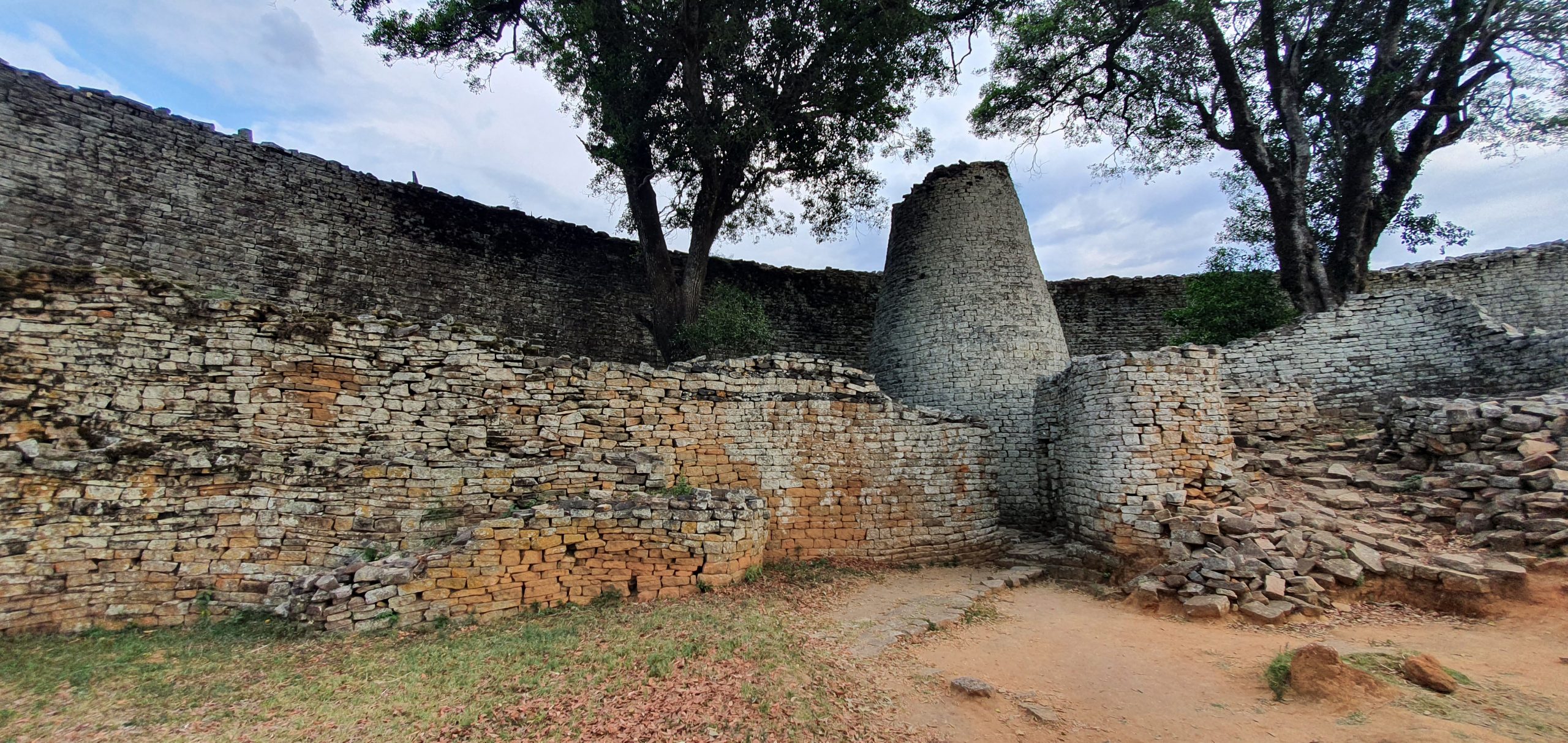
It is believed that Kalanga speaking societies first emerged in the middle Limpopo valley in the 9th century before moving on to the Zimbabwean highlands. The Zimbabwean plateau eventually became the centre of subsequent Kalanga states. The Kingdom of Mapungubwe was the first in a series of sophisticated trade states developed in Zimbabwe by the time of the first European explorers from Portugal. They traded in gold, ivory and copper for cloth and glass. From about 1250 until 1450, Mapungubwe was eclipsed by the Kingdom of Zimbabwe. This Kalanaga state further refined and expanded upon Mapungubwe's stone architecture, which survives to this day at the ruins of the kingdom's capital of Great Zimbabwe. From circa 1450–1760, Zimbabwe gave way to the Kingdom of Mutapa. This Kalanga state ruled much of the area that is known as Zimbabwe today, and parts of central Mozambique. It is known by many names including the Mutapa Empire, also known as Mwenehiwas hi for its gold trade routes with Arabs and the Portuguese. However, Portuguese settlers destroyed the trade and began a series of wars which left the empire in near collapse in the early 17th century.As a direct response to Portuguese aggression in the interior, a new Kalanga state emerged called the Rozwi Empire. Relying on centuries of military, political and religious development, the Rozwi (which means "destroyers") removed the Portuguese from the Zimbabwe plateau by force of arms. The Rozwi continued the stone building traditions of the Zimbabwe and Mapungubwe kingdoms while adding guns to its arsenal and developing a professional army to protect its trade routes and conquests. In 1834, the Ndebele people arrived while fleeing from the Zulu leader Shaka, making the area their new empire, Matabeleland. In 1837–38, the Rozwi Empire along with other Shona states were conquered by the Ndebele, who arrived from south of the Limpopo and forced them to pay tribute and concentrate in northern Zimbabwe.


Colonial era (1888–1965)


In the 1880s, the British arrived with Cecil Rhodes's British South Africa Company. In 1898, the name Southern Rhodesia was adopted.In 1888, British colonialist Cecil Rhodes obtained a concession for mining rights from King Lobengula of the Ndebele peoples.Cecil Rhodes presented this concession to persuade the government of the United Kingdom to grant a royal charter to his British South Africa Company (BSAC) over Matabeleland, and its subject states such as Mashonaland. Rhodes sought permission to negotiate similar concessions covering all territory between the Limpopo River and Lake Tanganyika, then known as 'Zambesia'. In accordance with the terms of aforementioned concessions and treaties,Cecil Rhodes promoted the colonisation of the region's land, with British control over labour as well as precious metals and other mineral resources.In 1895 the BSAC adopted the name 'Rhodesia' for the territory of Zambesia, in honour of Cecil Rhodes. In 1898 'Southern Rhodesia' became the official denotation for the region south of the Zambezi, which later became Zimbabwe. The region to the north was administered separately by the BSAC and later named Northern Rhodesia (now Zambia).


The Shona staged unsuccessful revolts (known as Chimurenga) against encroachment upon their lands, by clients of BSAC and Cecil Rhodes in 1896 and 1897.Following the failed insurrections of 1896–97 the Ndebele and Shona groups became subject to Rhodes's administration thus precipitating European settlement en masse which led to land distribution disproportionately favouring Europeans, displacing the Shona, Ndebele, and other indigenous peoples.


Southern Rhodesia became a self-governing British colony in October 1923, subsequent to a 1922 referendum. Rhodesians served on behalf of the United Kingdom during World War II, mainly in the East African Campaign against Axis forces in Italian East Africa.


In 1953, in the face of African opposition,Britain consolidated the two colonies of Rhodesia with Nyasaland (now Malawi) in the ill-fated Federation of Rhodesia and Nyasaland which was dominated by Southern Rhodesia. Growing African nationalism and general dissent, particularly in Nyasaland, persuaded Britain to dissolve the Union in 1963, forming three colonies. As colonial rule was ending throughout the continent and as African-majority governments assumed control in neighbouring Northern Rhodesia and in Nyasaland, the white-minority Rhodesia government led by Ian Smith made a Unilateral Declaration of Independence (UDI) from the United Kingdom on 11 November 1965, effectively repudiating the British plan that the country should become a multi-racial democracy. The United Kingdom deemed this an act of rebellion, but did not re-establish control by force. The white-minority government declared itself a "republic" in 1970. A civil war ensued, with Joshua Nkomo's ZAPU and Robert Mugabe's ZANU using assistance from the governments of Zambia and Mozambique. Although Smith's declaration was not recognised by the United Kingdom nor any other significant power, Southern Rhodesia dropped the designation 'Southern', and claimed nation status as the Republic of Rhodesia in 1970.

Independence and the 1980s

Zimbabwe Rhodesia regained its independence as Zimbabwe on April 18, 1980. The government held independence celebrations in Rufaro stadium in Salisbury, the capital. Lord Christopher Soames, the last Governor of Southern Rhodesia, watched as Charles, Prince of Wales, gave a farewell salute and the Rhodesian Signal Corps played God Save the Queen, the anthem of Commonwealth realms. Many foreign dignitaries also attended, including Prime Minister Indira Gandhi of India, President Shehu Shagari of Nigeria, President Kenneth Kaunda of Zambia, President Seretse Khama of Botswana, and Prime Minister Malcolm Fraser of Australia, representing the Commonwealth of Nations. Bob Marley sang 'Zimbabwe', a song he wrote, at the government's invitation in a concert at the country's independence festivities.

Read 961 times Last modified on Wednesday, 12 December 2012 13:46
Login to post comments

About Us

Zimbabwe is a song which, once heard, is never forgotten; a mood to suit the needs of any soul, any time; a spell that binds all those who know her. Her voice brings forth many melodies. Welcome to Zimbabwe, a land rich in diversity ranging from low-lying semi-desert to lush highlands strewn with forests and lakes. Situated on a high plateau in Southern Africa and covering 390 245 Km.

Social Icons

Newsletter

Sign Up for Our Newsletter:

You are here: Home
Scroll to Top